SEO Is Slowing Down. Here's Why GEO Is Where AI Search Attention Is Going in 2026
SEO Is Slowing Down. Here's Why GEO Is Where AI Search Attention Is Going in 2026
Quick answer: GEO (Generative Engine Optimization) is the practice of optimizing content so AI systems like ChatGPT, Perplexity, and Google AI Overviews cite and recommend it directly in their answers — instead of, or alongside, ranking it in a traditional list of blue links. It matters now because 37% of consumers already start their searches with AI tools instead of Google, AI-referred traffic converts at multiples of traditional organic traffic, and the sources AI platforms cite are frequently different from the pages that rank on page one of Google. GEO doesn't replace SEO — but a business that ignores it is optimizing for a shrinking share of how people actually search.
What Is GEO, and How Is It Different From SEO?
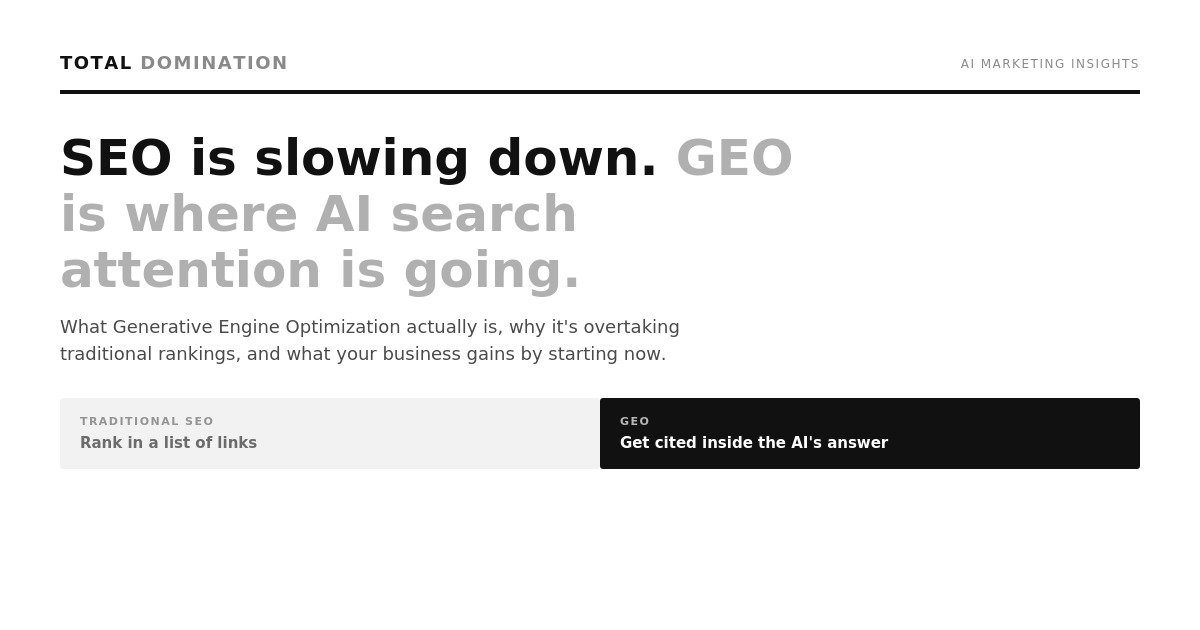
Traditional SEO optimizes a page to rank highly in a list of search results — the goal is a top position, measured by clicks. GEO optimizes content to be selected, quoted, or cited by an AI system generating a direct answer — the goal is inclusion in that answer, which often produces no click at all but still shapes what the user believes and trusts about a brand.
The mechanics are genuinely different, not just a rebrand of the same tactics:
That last row matters more than it looks. Google's AI Overviews tend to draw from pages that already rank well in regular Google search. But ChatGPT and Perplexity behave differently — a large share of the sources they cite do not appear in Google's top rankings at all, and ChatGPT specifically tends to favor pages that would rank well outside the top 20 in traditional search. In other words: ranking #1 on Google no longer guarantees you show up in an AI answer, and showing up in an AI answer doesn't require ranking #1 on Google.
Why Is GEO Becoming More Important Than SEO?
People Are Already Starting Their Search Journey in AI, Not Google
More than a third of consumers now begin searches with an AI tool instead of a traditional search engine — a shift that didn't exist at meaningful scale two years ago. ChatGPT alone has grown past 900 million weekly active users, more than doubling in under a year. Google's own AI Overviews now appear in roughly half of all searches, with that share projected to keep climbing.
AI-Referred Traffic Converts Significantly Better
This is the part that should get a business owner's attention: when someone does click through from an AI answer, that traffic converts at a meaningfully higher rate than traditional organic traffic — multiple independent industry reports put the multiple anywhere from 4x to over 20x, depending on the vertical and source. The visitors AI sends you have usually already had their questions partially answered and their trust partially built before they ever land on your page.
Zero-Click Is the New Normal — Which Makes Citation the New Ranking
A large majority of AI-driven searches now end without a click to any external website at all. That sounds like bad news, but it reframes the actual goal: being the source an AI trusts enough to cite by name builds brand recognition and trust even when nobody clicks through — something a rank-9 Google listing never did for you anyway.
AI Platforms Reward Different Things Than Search Engines Do
Foundational research on AI citation behavior found that adding concrete statistics, expert quotations, and clear structured data to a page increased its citation rate by up to 40% — well above what traditional keyword-density tactics achieve. Nearly half of what AI systems cite comes from the first third of a page's content, which means burying your best point in paragraph six is actively working against you in a way it never did for traditional SEO.
What Does a Business Get From Starting GEO Now?
- A head start while the field is still open. Since AI platforms frequently cite different sources than Google's top 10, the competitive landscape for GEO isn't the same as the one you've spent years fighting for in SEO — a business starting today isn't several years behind established competitors the way it would be in classic SEO.
- Higher-intent, higher-converting traffic. The visitors who do click through from an AI answer arrive further along in their decision — which shows up directly in conversion rate, not just traffic volume.
- Brand visibility that doesn't depend on a click. Being mentioned by name in an AI answer builds recognition and trust even in the majority of cases where the user never visits the site — a form of visibility traditional rank tracking doesn't even measure.
- Content that rewards freshness and structure over sheer age. A well-structured page published recently can outperform a much older page that still ranks well in traditional search — meaning GEO doesn't require years of accumulated domain authority to start showing results.
- A compounding advantage as AI search keeps growing. The market for AI-driven search optimization is growing at a rate far outpacing traditional SEO spend — businesses building the habit now are building it while it's still forming, not after it's already standard practice.
FAQ
Does GEO replace SEO?No. Traditional search engines still handle the large majority of global search volume, and a meaningful share of what AI platforms cite still overlaps with pages that already rank well organically. GEO is an additional, increasingly important layer — not a replacement for foundational SEO work.
How long does it take to see results from GEO?Because AI systems favor freshly published, well-structured content over sheer page age, businesses can see citation and mention activity meaningfully faster than the timeline typically associated with ranking a new page in traditional organic search — though building consistent, compounding visibility still takes sustained effort over months, not days.
What's the single highest-leverage first step for a business starting GEO?Restructure existing high-value content — service pages, case studies, FAQs — to lead with a direct, specific answer in the first few sentences, backed by real numbers. That single change addresses the factor research has tied most directly to AI citation rate.